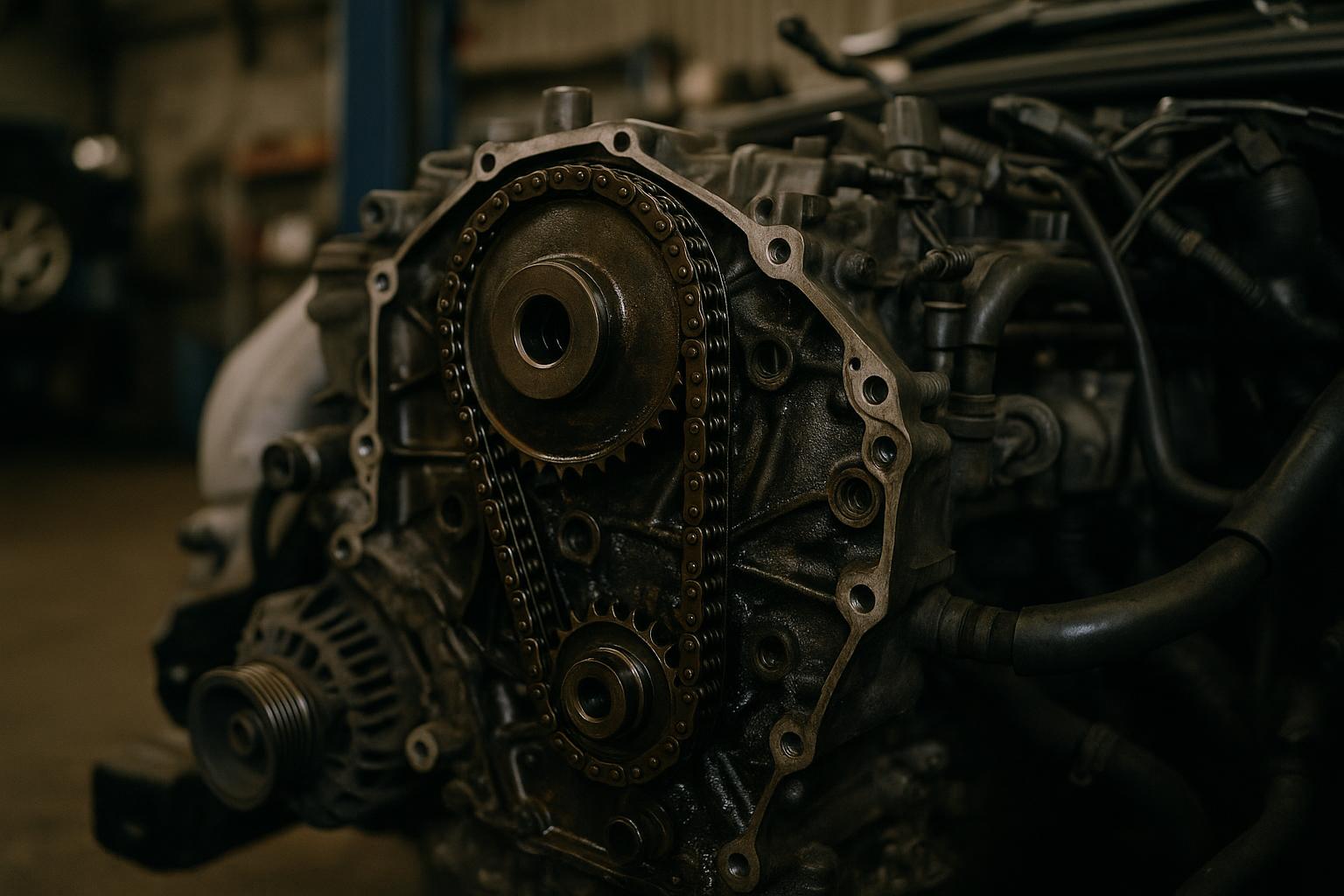
The timing chain is one of those parts you never see and rarely think about, right up until it starts making noise. It quietly does one of the most important jobs in your engine, and when it begins to wear it usually warns you first. The trouble is that the early signs are easy to brush off as normal age. Ignore them for too long and a stretched or snapped chain can wreck the engine completely. This guide explains what the timing chain does, the warning signs worth taking seriously, and why catching the problem early saves you a far bigger bill.
What a timing chain actually does
Your engine has two main rotating shafts that have to move in perfect step with each other. The crankshaft turns as the pistons go up and down. The camshaft opens and closes the valves that let fuel and air in and exhaust gases out. The timing chain links the two so they stay in sync. If the valves open at the wrong moment, the engine runs badly or not at all.
The chain runs on sprockets at each end and is held tight by a tensioner, with guides keeping it on its path. Over many miles the chain stretches slightly and the guides and tensioner wear. A small amount of slack changes the timing just enough to upset how the engine runs. Too much slack and the chain can jump a tooth on the sprocket or, in the worst case, break.
The warning signs you should not ignore
Most timing chain problems build up gradually, so you have a window to act. Watch for these.
A rattle on cold start that settles
This is the classic one. You start the car after it has sat overnight and there is a rattle or chatter from the front of the engine for a few seconds, then it goes quiet as the oil pressure builds and the tensioner takes up the slack. That noise is the chain slapping against worn guides before the tensioner fills with oil. A rattle that fades is an early warning. A rattle that stays is more urgent.
Misfires and rough running
When the chain stretches, the camshaft falls slightly out of time with the crankshaft. The valves no longer open at exactly the right moment, so the engine misfires, idles roughly, or feels like it is stumbling. You might notice it most at idle or when pulling away.
Hard starting
An engine that takes longer to fire up, or cranks several times before it catches, can point to timing that has drifted. If the chain has jumped a tooth, the engine may struggle badly to start or refuse altogether.
The engine warning light
Worn timing throws off the readings from the camshaft and crankshaft position sensors, and the engine management system notices. It often logs a fault and turns on the warning light. If your light has come on, our guide to dashboard warning lights explains what the common ones mean, and a proper car diagnostics check will read the stored codes so you know what the car is complaining about.
Metal flakes in the oil
As the chain and guides wear, tiny metal particles end up in the oil. If you spot fine metal flecks when you check the dipstick or during an oil change, that is a sign of internal wear that needs looking at. It is one reason regular servicing matters: fresh oil keeps the tensioner working properly and gives you a chance to catch problems early.
Loss of power
If the engine feels flat, sluggish, or down on its usual pull, worn timing could be the cause. When the valves are even slightly out of step, the engine cannot breathe as it should, and performance drops off.
If you hear a rattle on cold start, the safest thing is to get it checked sooner rather than later. The repair is far cheaper than a new engine.
Why a worn chain can wreck the engine
Many modern engines are what mechanics call interference engines. In these, the valves and pistons share the same space but at different moments, kept apart only by correct timing. If the chain snaps or jumps several teeth, that timing is lost. A valve can be open when a piston rises to meet it, and the two collide.
The result is bent valves, and in bad cases damaged pistons, a cracked cylinder head, or a scored block. At that point you are looking at a major engine repair or a replacement engine, which costs many times more than replacing the chain before it failed. This is exactly why the early warning signs matter so much. The chain gives you notice. The damage from ignoring it does not.
Timing chain or timing belt: the difference
Not every engine has a chain. Some use a timing belt, a toothed rubber belt that does the same job. The key difference is lifespan and maintenance. A belt is a service item that the manufacturer says to replace at a set mileage or age, whether or not anything is wrong, because a snapped belt causes the same engine damage as a snapped chain.
A chain is designed to last much longer, often the life of the engine, and is not on a fixed replacement schedule. It is replaced when it wears out rather than at a set interval. So if your engine has a chain, the warning signs above are your cue. There is no service reminder telling you the day it needs doing. If you are not sure which your car has, just ask us when you call.
Why the guides and tensioner go in with the chain
When we replace a timing chain we fit new guides and a new tensioner at the same time. There are good reasons for this. The old guides and tensioner have worn alongside the chain, so reusing them on a fresh chain would let it slap and stretch all over again. The bulk of the cost in this job is the labour to open up the front of the engine and reach the chain, so it makes no sense to do that work twice. Fitting everything new together means the repair lasts and you are not back in a year later.
Most timing chain jobs take about a day, depending on the vehicle, because reaching the chain means removing a fair amount to get to it. We do both bodywork and mechanical work under one roof in Tottenham Hale, so if anything else needs attention it can be sorted in the same visit.
Get it checked before it gets worse
If your engine is rattling on cold start, misfiring, or showing a warning light, do not wait for it to get louder. Book a timing chain replacement assessment with us and we will tell you honestly what the car needs. We work on cars and vans of all makes and cover North London from our Tottenham Hale workshop.
Quotes are free. Call us on 020 3582 3444 or message us on WhatsApp. We are open every day, 08:00 to 22:00, at 59 Garman Rd, London N17 0UN.
Good to know
How do I know if my car has a timing chain or a timing belt?+
It depends on the engine. Belts are replaced at a set mileage or age, while chains are designed to last much longer and are replaced when they wear out. If you are not sure which your car has, call us with the make and model and we will tell you.
Can I keep driving with a rattling timing chain?+
It is risky. A rattle on cold start often means worn guides and a stretching chain. If the chain jumps or snaps, the valves can hit the pistons and cause major engine damage. Get it checked before it gets worse.
How long does a timing chain replacement take?+
Most timing chain jobs take about a day, depending on the vehicle, because reaching the chain means removing a fair amount of the front of the engine. We replace the guides and tensioner at the same time so the repair lasts.
Why do you replace the guides and tensioner with the chain?+
The guides and tensioner wear alongside the chain. Fitting a new chain against worn parts would let it slap and stretch again. Since most of the cost is the labour to open up the engine, replacing everything together means the job is done once and lasts.


Get a free, no-obligation quote
Bodywork and mechanical under one roof in Tottenham Hale. Open every day, 08:00 to 22:00. Call, message on WhatsApp, or request a quote.